What do employers look for beyond experience? Discover how adaptability, initiative, and transferable skills can help you stand out in job interviews.
This past summer, I found myself sitting through three job interviews after years away from the interviewing process.
I expected the usual questions about my experience, qualifications, and professional background.
And while those questions certainly came up, something about these interviews felt different.
I couldn’t quite explain it at first.
The conversations seemed to focus less on whether I had performed a particular task before and more on how I would approach situations that weren’t entirely familiar to me.
One employer was navigating major system changes. Another seemed particularly interested in someone who could take initiative. And during a third interview, I found myself discussing how I approached problems when even the people around me didn’t have all the answers.
At the time, I treated each interview as its own experience.
It wasn’t until afterward, when I began reflecting on all three, that I noticed a common thread.
One interviewer had even described it directly: they were looking for strong people.
But what did that actually mean?
After two job offers, one rejection, and ultimately accepting the opportunity I preferred, I started thinking more carefully about what these conversations had revealed.
Not just about interviewing, but about the qualities we develop through our everyday experiences at work and in other parts of our lives.
🌿 The First Interview: When Nobody Has All the Answers
My first interview was in person with a panel.
Since I hadn’t interviewed in years, I wasn’t entirely sure what to expect. But I appreciated how straightforward the conversation became.
The interviewers explained that the company was going through significant changes, including transitions involving its enterprise resource planning (ERP) systems and other processes.
They were candid about the uncertainty.
Not everything had been figured out. Some processes were still changing, and the people already working there didn’t necessarily have every answer.
What stood out was the kind of person they said they needed.
They weren’t simply looking for someone who could follow established instructions.
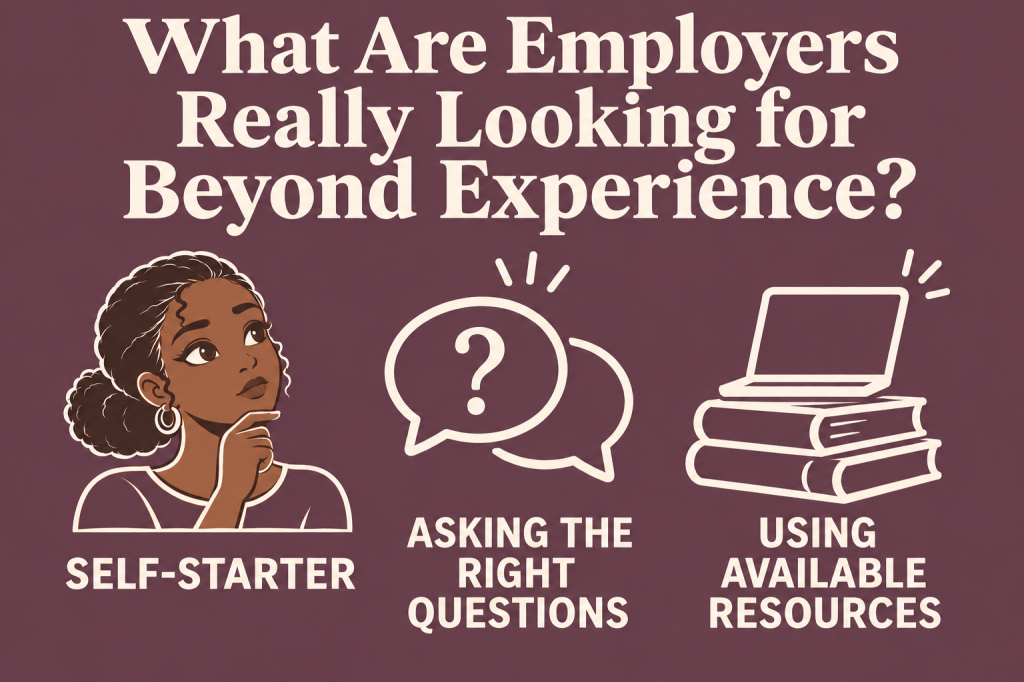
They wanted someone comfortable navigating unfamiliar systems, identifying useful information, and putting pieces together without waiting for someone else to explain every step.
That caught my attention because I recognized those experiences from my own career.
I had worked through system changes, shifting responsibilities, and situations where I needed to figure out how something worked before I could move forward.
Sometimes that meant asking questions of the right people.
Other times it meant researching a process, reviewing available information, or using AI tools as a starting point to help me understand a problem.
The important part wasn’t the tool itself. It was knowing how to use available resources, verify information, and continue working toward an answer.
As I shared those experiences, the interviewers seemed increasingly interested.
They told me it was one of their longest interviews, and the conversation eventually began to feel almost like they were explaining why I should want to join them.
I enjoyed that openness.
It was a refreshing first experience after being away from the interviewing process for so long.
I ultimately wasn’t convinced the position was the right fit for me, but I left with something valuable.
I had been reminded that the way we approach unfamiliar problems can be just as important to discuss as the tasks we’ve already completed.
🧩 The Second Interview: When I Questioned My Own Readiness
My second interview was different.
It wasn’t an in-person panel, and the conversation felt less comfortable to me.
As the interviewer described the position and its responsibilities, I began wondering whether they were actually looking for someone with more direct experience.
The opportunity had been presented as welcoming to people who were new to the field and interested in learning.
But as I listened, the expectations sounded more demanding than I had anticipated.
I started questioning whether my background would translate as well as I had hoped.
Eventually, I asked whether someone coming from a different department or professional area would be at a disadvantage compared with a candidate who already had direct experience.
Looking back, I wish I had approached that question differently.
I was trying to understand their expectations, which is a reasonable thing to do in an interview.
But I also recognize that my uncertainty may have influenced how I presented myself.
Instead of focusing on the experience I could bring and how I would learn the unfamiliar parts of the role, I began emphasizing what I hadn’t done.
I remember feeling that the energy of the conversation shifted afterward.
Not long after the interview, I received an email explaining that they had selected another candidate.
I appreciated receiving that communication, especially because job seekers don’t always receive a clear response.
I also knew I couldn’t say for certain why I hadn’t been selected.
There may have been another candidate whose background aligned more closely with the position. There may have been other considerations I knew nothing about.
Still, the experience gave me something to reflect on before my final interview.
There is a difference between acknowledging what you don’t know and allowing what you don’t know to overshadow what you can contribute.
That distinction stayed with me.
🎯 The Third Interview: Showing How I Figure Things Out
By the time my third interview arrived, I had two recent experiences to draw from.
I knew I wanted to be more intentional about how I communicated my abilities.
This opportunity also involved moving into an area that was different from my previous work.
But instead of focusing primarily on that difference, I thought about the skills and experiences I could bring with me.
I had spent years navigating changing processes, working independently, and becoming someone leadership could approach when they needed help resolving a problem.
I understood how to ask questions without expecting someone else to do all the thinking for me.
I knew how to identify useful resources, follow through on an issue, and make a decision when I had gathered enough reliable information to support it.
And when I didn’t know something, I had experience learning what I needed to know.
During the panel interview, I focused on those examples.
I talked about adapting to unfamiliar systems, using technology to support my work, communicating with different people, and taking responsibility for reaching a reasonable conclusion.
I wasn’t trying to convince the interviewers that I already knew everything about the position.
I wanted them to understand how I approached learning and problem-solving.
That conversation felt much stronger.
I could see that the panel appreciated the examples I shared.
Eventually, I received an offer and accepted the position.
Looking back at the three interviews, I began recognizing that the strongest examples I had weren’t necessarily the ones where everything went smoothly.
They were the ones where something was unfamiliar, the instructions were incomplete, or the situation required me to take an active role in finding a solution.
🔍 What Does Being a Strong Candidate Actually Mean?
After those interviews, I kept thinking about the phrase strong people.
At first, it might sound like employers are simply asking for confident personalities, extensive experience, or people who can handle a heavy workload.
But that wasn’t exactly what I heard in my conversations.
What stood out was the emphasis on people who could contribute when circumstances weren’t ideal.
People who could learn.
People who could adapt.
People who could ask useful questions.
People who could take ownership without needing constant direction.
Of course, different employers define a strong candidate differently. Technical knowledge, collaboration, judgment, and communication can all matter depending on the role.
And needing training or guidance doesn’t make someone a weak employee.
But my interviews reminded me that there’s a meaningful difference between saying you’re willing to learn and showing someone how you’ve learned in the past.
Almost anyone can describe themselves as adaptable.
It’s more revealing to explain a time when a system changed, a familiar process stopped working, or you had to solve a problem without a complete set of instructions.
What did you do first?
Who did you consult?
How did you decide which information was reliable?
What did you learn?
And how did you move forward?
Those experiences can tell a much fuller story about someone’s abilities than a list of adjectives.
I also began realizing that many of these qualities weren’t things I developed specifically for job interviews.
They came from years of participating in different environments and learning how to contribute.
🤝 What Being a Regular Taught Me About Participating
One idea I’ve explored often through Self-Care Portfolio is the value of becoming a regular.
Whether it’s a gym, library, community organization, or another shared space, there’s something valuable about returning consistently.
Over time, unfamiliar environments become more familiar.
You begin recognizing people, understanding routines, and learning how things work.
Eventually, you may become comfortable enough to participate in ways that felt intimidating when you first arrived.
I’ve usually thought about this in terms of community and social connection.
But my interviews made me consider how the same process can support professional development.
In a workplace, becoming familiar with an environment involves more than knowing where things are or remembering everyone’s name.
You begin understanding the systems people use.
You learn where to find information.
You recognize which questions require guidance and which problems you can investigate independently.
You become more familiar with how your work connects to other people’s responsibilities.
And with experience, you may become more comfortable contributing ideas, making decisions, and taking initiative.
That doesn’t mean you need to be the loudest person in the room.
It doesn’t mean becoming everyone’s friend or pretending to know something you don’t.
Sometimes active participation looks like listening carefully, asking one useful question, or following through on a responsibility without needing to be reminded.
Other times it means recognizing that a process isn’t working and helping identify a better approach.
Being an active participant isn’t about always having the answer. It’s about becoming involved in the process of finding one.
That’s a quality we can develop through many different parts of life.
Joining a new group, volunteering, learning a hobby, returning to school, or becoming comfortable in a workplace can all give us opportunities to practice navigating unfamiliar situations.
The experiences may look different, but some of the skills carry over.
🌱 You Don’t Have to Arrive Knowing Everything
I think one of the more reassuring lessons from these interviews is that being new to something doesn’t automatically mean you have nothing to offer.
When we’re considering a career change, applying for a different position, or entering an unfamiliar environment, it’s easy to focus on what we haven’t experienced.
We compare our background with the job description.
We notice responsibilities we’ve never held.
We wonder whether another candidate already knows the systems, terminology, or procedures.
Those are reasonable considerations.
Some positions genuinely require specialized experience, and not every opportunity will be the right fit.
But it’s also worth considering what we’ve already learned through other experiences.
Perhaps you’ve worked through major organizational changes.
Maybe you’ve taught yourself a new system, helped resolve a complicated issue, or learned how to collaborate with people who approach problems differently.
Maybe you’ve become the person others rely on because you follow through.
Those experiences matter, even when they happened in a different industry or position.
The challenge is learning to recognize them and communicate them clearly.
My second interview reminded me that I could ask better questions about an unfamiliar role without framing my background primarily as a disadvantage.
My third interview gave me an opportunity to apply that lesson.
And my first interview showed me that some employers may be especially interested in how someone navigates uncertainty.
Together, those experiences changed how I think about preparing for future opportunities.
Instead of asking only, Have I done this exact job before?
I also want to ask:
What have I already done that demonstrates how I could learn, contribute, and grow in this environment?
🌼 Self-Care Takeaways
- Prepare stories, not just descriptions of your strengths. Rather than simply saying you’re adaptable or independent, think of specific situations where you’ve demonstrated those qualities.
- Recognize your transferable skills. Experience with problem-solving, communication, technology, collaboration, and navigating change can remain valuable when moving between roles or industries.
- Ask questions without automatically discounting your background. It’s reasonable to clarify training and expectations. You can do that while still recognizing the experience you bring.
- Show how you approach unfamiliar situations. Employers may be interested in how you research, learn, verify information, seek guidance, and make decisions—not just what you already know.
- Pay attention to what the interview reveals about the workplace. An employer’s expectations can help you decide whether the environment and position are right for you, too.
- Develop professional skills through everyday participation. Taking initiative, following through, and learning how to contribute in shared environments can build abilities that extend beyond a single job.
❓ Frequently Asked Questions
What do employers look for beyond work experience?
Depending on the role, employers may value adaptability, communication, problem-solving, initiative, sound judgment, and the ability to learn unfamiliar processes. Specific examples from previous experiences can help demonstrate those qualities.
How do I interview for a job when I don’t have direct experience?
Focus on relevant transferable skills and situations where you’ve learned new responsibilities successfully. Be honest about what you haven’t done while explaining how your existing experience could help you contribute.
How can I show initiative during a job interview?
Describe a real situation where you identified a problem, researched possible solutions, consulted appropriate people, and followed through. Explain your reasoning and the outcome rather than simply calling yourself a self-starter.
🌸 Final Reflection
I went into those three interviews thinking primarily about how my experience would translate into a new position.
I came away thinking more about how I approach the unfamiliar.
The first interview reminded me of the value of being resourceful when processes are changing.
The second made me reflect on how easily uncertainty can influence the way I present my own abilities.
And the third gave me an opportunity to communicate those abilities with greater clarity.
I didn’t receive every offer, and I didn’t want every position.
But each experience gave me something useful.
What stayed with me most was the realization that professional growth doesn’t happen only when we receive a promotion, earn another credential, or accept a new job.
It also happens through the ordinary situations where we learn to participate more fully.
The questions we ask.
The problems we work through.
The changes we adapt to.
The responsibilities we follow through on.
Those experiences gradually shape how we approach the next unfamiliar situation.
And perhaps that’s one of the most useful things we can bring into an interview.
Not the promise that we’ll know everything from the beginning.
But evidence that we’ve learned how to keep going when we don’t.
Sometimes being a strong candidate isn’t about already knowing what to do. It’s about being able to show how you figure out what to do next.
Subscribe
Want more self-care strategies and career reflections? Join to get new posts sent straight to your inbox.
Related read:
Six Ways to Show Your Professional Value Beyond Job Title – selfcareportfolio
How to Be a Regular (and Why It’s the Easiest Way to Make Friends as an Adult) – selfcareportfolio

