
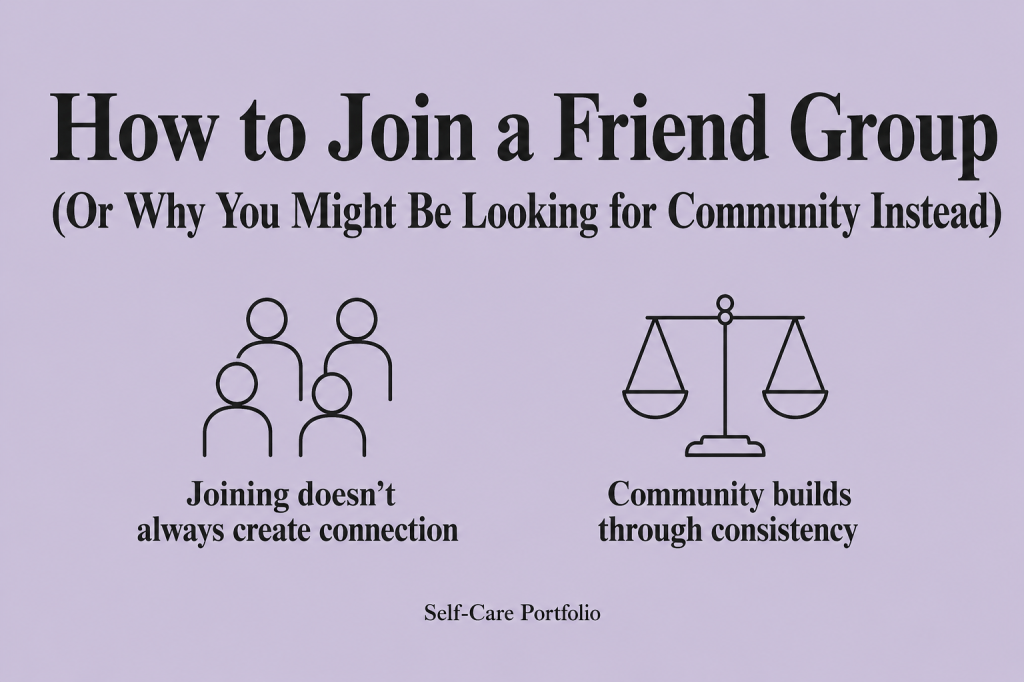
Learn the difference between a friend group and community. A thoughtful look at belonging, loose ties, and building connection in your 30s.
A few weeks ago, I saw a post on Instagram that said there’s a difference between having friends and having community.
It stopped me.
For most of my adult life, I’ve met people through someone else — a college friend introducing me to their circle, a coworker bringing me into a group dinner, being welcomed into someone’s family or friend network. I’ve always appreciated that. I like one-on-one connection. I also like being invited in.
But when I looked back over the past few years, I realized something had quietly shifted.
Joining my alumni association for three years.
Signing up for a six-week adult tennis class.
Becoming part of a CrossFit community (through a friend) that I still attend today.
Those weren’t just friendships. They were communities.
And I began to notice that the growth I experienced in community spaces felt different — and sometimes deeper — than what I felt when simply being added to someone else’s friend group.
Sometimes the question isn’t just how to join a friend group.
It’s whether you’re actually looking for friends — or community.
Why I Used to Seek Friends (and What That Gave Me)
When you’re trying to build connection as an adult, seeking friends feels natural.
You meet someone you like.
You hope to get invited into their circle.
You try to read the dynamics and not overstep.
There’s a certain comfort in that structure. Someone else already has a group. You’re being welcomed in. The social lines are drawn, and you find your place.
That gave me:
- One-on-one intimacy
- Dinners, movies, and small gatherings
- A sense of being chosen
And there’s nothing wrong with that. Friendships are deeply important. They create emotional safety and shared history.
But I also noticed something subtle.
When you enter someone else’s group, you’re entering their ecosystem. It’s their network. Their rhythm. Their long-standing bonds.
You can belong — but you’re not shaping it.
What Community Gave Me That Friendship Didn’t
Community felt different.
When I joined my alumni association, I wasn’t someone’s guest. I was a participant.
When I signed up for tennis, we were all beginners together.
When I joined CrossFit, the structure of the workouts leveled the field — we showed up, struggled, improved, and left together.
Community gave me:
- Shared structure
- Repeated exposure
- A collective goal
- Growth through participation
It wasn’t always intimate. It wasn’t always personal. But it was energizing.
I stopped needing to organize my entire social life one-on-one.
Instead, I showed up to something bigger than me — and relationships formed inside that structure naturally.
Why Joining a Friend Group Feels Harder Than Joining a Community
When you try to “join a friend group,” you’re often trying to enter an already bonded unit.
That can feel vulnerable.
You may wonder:
- Am I invited — or tolerated?
- Am I overstepping?
- Is this temporary or permanent?
Community works differently.
You’re not entering a closed circle.
You’re entering a shared activity.
The structure carries the weight.
That’s why joining a tennis class or a gym or a volunteer board often feels easier than trying to integrate into a tight-knit social group.
You’re not forcing belonging.
You’re participating.
And participation naturally creates familiarity.
The Power of Loose Ties (and Why They Matter)
There’s a concept in Meg Jay’s book The Defining Decade called “loose ties” — people you know through shared environments but aren’t deeply intimate with — who often provide more opportunity than your closest circle.
I’ve felt that firsthand.
When I needed professional references for something major, I realized I didn’t want to ask someone from my inner circle. I reached toward my community — people I had worked alongside in my alumni and young professional associations.
It felt appropriate.
We had shared time, shared effort, shared visibility.
But not overexposure.
That balance mattered.
Community creates identity capital. It allows people to see you in action over time. And sometimes that visibility opens doors in ways friendship alone does not.
How to Know What You’re Actually Seeking
If you’re trying to join a friend group, pause for a moment and ask:
- Do I want intimacy right now — or shared experience?
- Am I looking for emotional closeness — or structured belonging?
- Do I want dinners and deep talks — or collective growth and momentum?
Both are valid.
But they are different.
Friendships tend to form through chemistry and intentional one-on-one time.
Community tends to form through structure and repeated participation.
You don’t have to choose one forever.
But knowing what you’re looking for changes how you approach it.
A Practical Way to Start (Without Forcing It)
If joining a friend group feels heavy or awkward, try shifting the entry point.
Instead of asking:
“How do I get into their circle?”
Ask:
“What shared structure can I join?”
Examples:
- An alumni organization
- A sports league or class
- A volunteer board
- A gym community
- A recurring library event
- A group tied to a hobby or interest
Let the activity hold the connection.
From there, intimacy can grow — or not. But you won’t be chasing it.
Self-Care Takeaways
🌿 1. Friendship and community are not the same — and both serve different seasons of life.
🧩 2. Joining a structured space is often easier than entering a pre-existing friend group.
🧠 3. Community builds familiarity through repetition, not pressure.
🤝 4. Loose ties can be just as valuable as close ones — sometimes even more.
📍 5. Participation creates belonging faster than performance.
✨ 6. Knowing what you’re seeking reduces social frustration.
🔁 7. You don’t have to abandon friendships to pursue community — they can coexist.
Final Reflection
There’s nothing wrong with wanting friends.
There’s nothing wrong with wanting community.
But if you feel stuck trying to integrate into someone else’s group, it may not be a rejection — it may just be a mismatch in structure.
Friendship is built through closeness.
Community is built through participation.
Sometimes the most sustainable way to connect isn’t to enter someone’s circle —
it’s to stand beside them in something shared.
And over time, that shared space becomes its own kind of belonging.
Subscribe
Want more reflections on habits, connection, and self-care? Subscribe below to get updates when new posts go live.
Related reads:
How to Join a Friend Group When You’re the New Person – selfcareportfolio
How to Be a Regular (and Why It’s the Easiest Way to Make Friends as an Adult) – selfcareportfolio


One response to “How to Join a Friend Group (Or Why You Might Be Looking for Community Instead)”
[…] How to Join a Friend Group (Or Why You Might Be Looking for Community Instead) – selfcareportfolio […]
LikeLike