
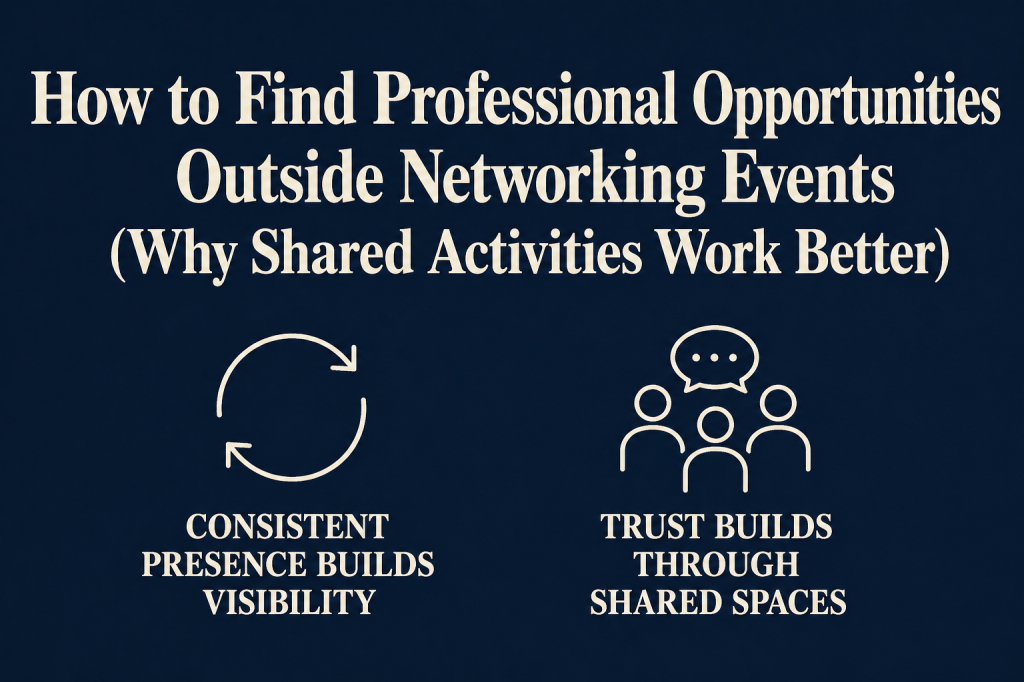
Learn how to find professional opportunities outside networking events. Discover how shared activities, consistent participation, and visibility help build trust and real career connections.
Submitting a very important application required something I don’t particularly enjoy: asking for references.
Three references, to be exact.
I sat with it for a while. Of course, friends who are professionals that fit the profile came to mind first. But I hesitated. Not because they wouldn’t support me — but because I didn’t want it to feel overly personal or heavy. I wanted people who had seen me in action.
So I opened LinkedIn and started scrolling.
Names surfaced from my alumni association. From service work. From being mentored. From events and shared spaces that weren’t intimate — but were consistent.
I asked four people.
Three signed by the end of the day.
Each message came back warm. Encouraging. Almost flattered that I had thought of them.
What stood out wasn’t speed — it was familiarity. These were people who had watched me contribute over time.
Sometimes career opportunities don’t come from strategic networking.
They come from consistent participation in familiar spaces.
Why One-Off Networking Events Feel Harder
There’s nothing wrong with networking events. They have their place.
But they’re built differently.
You walk in.
You introduce yourself.
You exchange information.
You hope someone remembers you.
The energy is compressed. Transactional. Often performative.
It’s difficult to vouch for someone you’ve only met once. There’s no shared context. No repeated exposure. No visible pattern of reliability.
You may leave with contacts — but not necessarily connection.
And without connection, opportunity rarely moves.
Familiar Spaces Create Identity Capital
Meg Jay calls this “identity capital” — the collection of experiences, skills, and visible contributions that build your adult identity over time.
Identity capital doesn’t grow in isolated moments.
It grows through consistent participation.
Volunteering.
Serving on a board.
Joining a fitness community.
Showing up to alumni events.
Attending the same creative group.
These aren’t just hobbies.
They’re spaces where people see how you show up.
They notice:
- Your reliability
- Your work ethic
- Your communication style
- How you treat others
- Whether you follow through
That visibility compounds quietly.
Loose Ties Carry Opportunity
Meg Jay also talks about “loose ties” — people you know through shared environments but who aren’t part of your inner circle.
Research often shows that opportunities tend to travel through these wider networks, not just our closest relationships.
When I looked at the people who signed my references, they weren’t random contacts.
They were loose ties built through consistent presence.
We weren’t best friends.
But we had shared effort.
Shared meetings.
Shared responsibility.
They had context.
And context builds trust faster than charisma ever could.
Community Spaces Create Professional Momentum
I’ve seen this outside of my own story, too.
A woman I know through a volunteer association once told me that she originally met the organization’s director through a book club. They weren’t networking — they were simply part of the same recurring space.
Over time, that familiarity mattered.
When a job opportunity came up that fit her background, the director thought of her and made the introduction. That connection eventually extended beyond the book club — into professional opportunity and shared leadership on the board.
It didn’t begin in a networking room.
It began in a consistent one.
Why?
Because she had seen her show up.
Participate.
Contribute.
Be engaged.
Activity-based spaces tend to draw people who care about something beyond themselves.
That creates an environment where professional opportunities feel natural — not forced.
Consistent Participation Beats Strategic Performance
Consistency doesn’t have to mean weekly.
It means showing up enough that your presence becomes familiar.
Networking events rely on performance.
Community spaces rely on participation.
Performance can impress.
Participation builds trust.
And trust is what moves opportunity.
Networking Doesn’t Have to Be Separate From Life
There’s a misconception that networking must happen in designated rooms.
Name tags.
Business cards.
Elevator pitches.
But often, networking is simply the byproduct of being involved.
Volunteering.
Fitness communities.
Alumni groups.
Creative workshops.
Service boards.
Passion projects.
These spaces allow people to see your character in motion.
Over time, that visibility becomes endorsement.
And endorsement opens doors.
Self-Care Takeaways
🌿 1. Opportunities often grow from places where you’ve shown up consistently.
🤝 2. Familiarity builds trust faster than one-time introductions.
🧠 3. Identity capital compounds through participation, not performance.
🔁 4. Consistency doesn’t have to be intense — it just has to be repeated.
📍 5. Loose ties can be just as powerful as close friendships in professional growth.
✨ 6. Community spaces can support both connection and career without feeling transactional.
Final Reflection
Looking back, I’m grateful I didn’t treat networking as something separate from my life.
The references I needed came from spaces I genuinely cared about.
Service.
Community.
Participation.
It reminded me that building something for yourself — even outside of work — is never wasted.
Networking doesn’t have to feel strategic.
Sometimes it simply looks like showing up.
And letting time do what it quietly does best.
Subscribe
Want more self-care strategies and career reflections? Join to get new posts sent straight to your inbox.
Related read:
Six Ways to Show Your Professional Value Beyond Job Title – selfcareportfolio
How to Join a Friend Group When You’re the New Person – selfcareportfolio
How to Be a Regular (and Why It’s the Easiest Way to Make Friends as an Adult) – selfcareportfolio

