
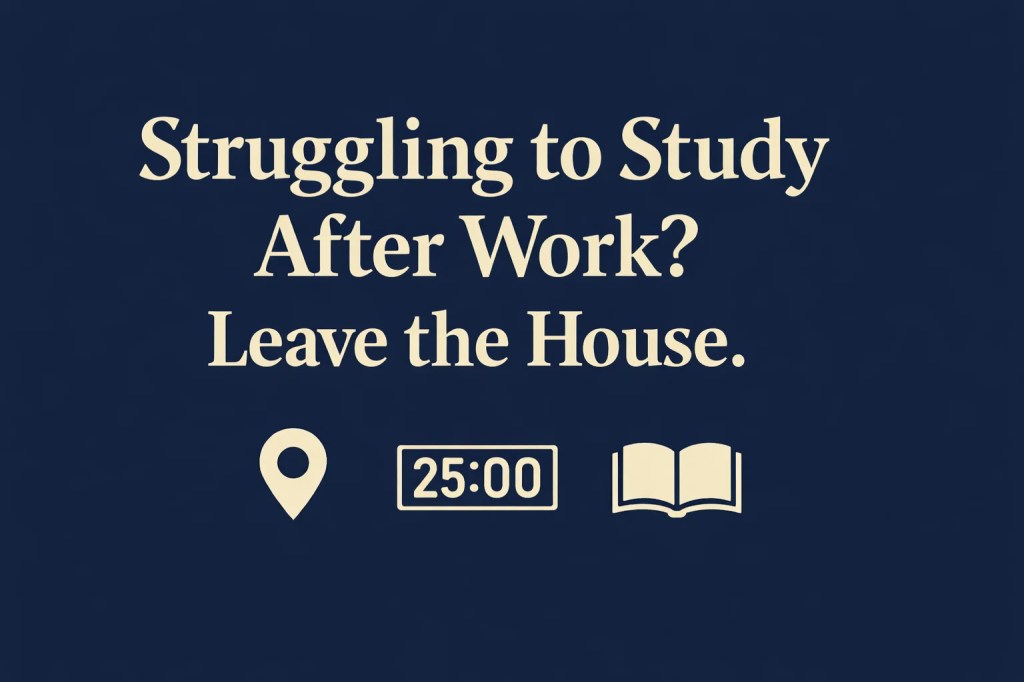
Struggling to study after work? Learn why studying outside the house makes consistency easier for working adults and how to structure 90–180 minute study sessions that actually stick.
If you work full-time and are trying to study after work, you already know the pattern.
You tell yourself you’ll start at 6.
Then 7.
Then 8.
Then suddenly the night is gone.
You weren’t lazy.
You were negotiating.
For me, the shift wasn’t motivation.
It was location.
The Real Problem Isn’t Discipline — It’s Environment
After a full workday, your home is wired for rest.
Comfort.
Food.
Television.
Scrolling.
Silence.
Even if you sit at your desk, your brain knows you’re “off.”
Studying at home requires constant self-negotiation:
“I’ll start after I eat.”
“I’ll start after this episode.”
“I’ll start in an hour.”
That’s exhausting.
Working adults don’t need more willpower.
We need fewer negotiations.
Why Leaving the House Changes Everything
Studying outside the house creates structure before you even open your laptop.
Here’s what it does:
1. It creates a boundary
When you arrive somewhere to study, you’ve mentally “clocked in” again — but on your terms.
2. It reduces decision fatigue
You’re already there.
The decision has been made.
3. It keeps you alert
Open, shared spaces naturally increase attentiveness.
You’re less likely to doze off or drift.
4. It raises the cost of quitting
If you drove 7–15 minutes, parked, and walked in, you’re far more likely to make it worthwhile.
The trip itself builds commitment.
How I Structured It (And What Made It Stick)
I keep it simple.
• I rotate between two consistent locations — a campus library and a nearby local library, both 7–15 minutes away.
• I go after eating and/or a short power nap so I’m not distracted by hunger or sleepiness.
• I don’t watch any of my favorite shows beforehand. That’s how you get stuck.
• I aim for a 90–180 minute study window.
Two to three hours feels ideal.
Less than 90 minutes doesn’t feel worth the transition.
Inside that window, I use the Pomodoro method for breaks.
But the key isn’t the timer.
It’s the relocation.
Why This Works Especially Well in Your 30s
When you’re juggling work, responsibilities, and life, energy is limited.
Studying outside the house protects that energy.
It removes:
• The temptation to “wait until later.”
• The comfort spiral of home.
• The constant push-and-pull of deciding when to begin.
For working adults, consistency is more important than intensity.
And environment supports consistency better than motivation ever will.
Self-Care Takeaways
🌿 1. Structure reduces stress more than willpower.
🧠 2. Environment shapes behavior more than intention.
⏳ 3. Protecting a 90–180 minute window is enough.
📍 4. Consistency beats perfect study marathons.
💛 5. Systems are a form of self-respect.
Studying outside the house isn’t about productivity.
It’s about protecting your long-term goals from daily exhaustion.
FAQs
Is it really better to study outside the house?
For many working adults, yes. A change of environment reduces distractions and self-negotiation, which increases follow-through.
How long should I study when I leave the house?
Aim for 90–180 minutes. That window makes the trip feel worthwhile without requiring burnout sessions.
What if I’m too tired after work?
Eat or take a short power nap first. Then go directly to your study location. Avoid watching TV beforehand — that’s usually when momentum disappears.
Should I study at a coffee shop or library?
Choose a space that feels structured and distraction-light. Libraries often work best for focused study blocks.
How many days per week should I do this?
Start with 2–3 days. Consistency matters more than daily intensity.
Closing Note
You don’t need longer study hours.
You need fewer negotiations.
If leaving the house removes friction and protects your focus, it’s not dramatic — it’s strategic.
Sometimes the smallest shift in environment is what keeps a long-term goal alive.
Subscribe to Self-Care Portfolio
If this post resonated, subscribe to the Self-Care Portfolio for more reflections and self-care experiments. Each post is a gentle reminder that progress doesn’t have to be perfect to count.
Related reads:
Going Back to School in My 30s Taught Me Something I Didn’t Expect – selfcareportfolio
The Semester Method: A Softer Approach to Goal Setting – selfcareportfolio
Why 30-Minute Naps Changed My Energy and Evenings – selfcareportfolio
 selfcareportfolio