What going back to school in my 30s taught me about timing, confidence, and presence and why starting later can feel more grounded than starting early.
A couple of people around me kept saying the same thing.
“You should go back to school.”
“You should have gone for accounting too.”
“It would give you more stability.”
I already had a finance degree, and while it served me well personally, it wasn’t as steady when it came to the work available where I live. Over time, I found myself moving in the direction of accounting professionally.
I knew they weren’t wrong.
But knowing something makes sense and being ready to act on it are two very different things.
So I put it off.
Two years passed quickly, the way time always does. And then something shifted. I moved back home, which put me fifteen minutes away from my alma mater. Suddenly, the excuses didn’t hold the same weight.
That’s when I remembered something someone once told me — advice that stayed with me more than I realized:
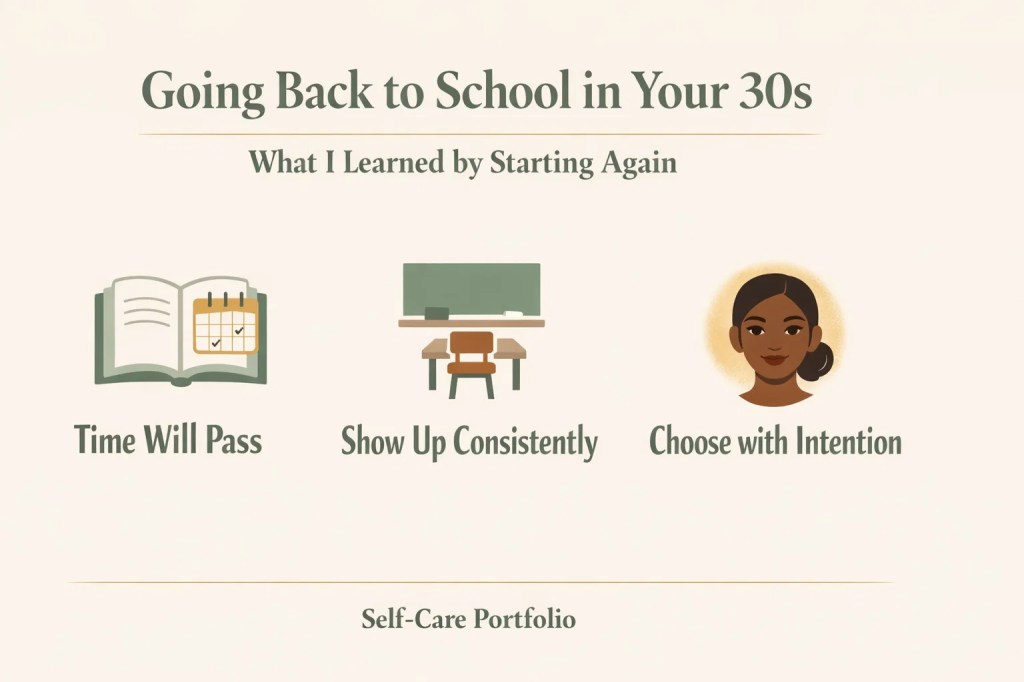
The time will pass anyway.
You can be older with the thing, or older without it.
So I went back.
Returning to School Felt Different This Time
Going back to school in my 30s didn’t feel anything like my first experience in my early 20s.
Back then, I skipped classes. I dropped courses. I retook classes more than once. I showed up inconsistently and treated school like something I could circle back to later.
This time, I showed up for class consistently.
I approached this opportunity differently not as something I could revisit later, but as something I was choosing to commit to now.
Part of that commitment came from advice I once received from someone who had gone through an intense professional program themselves. They told me they never skipped class — not even on days when it would have been understandable to do so. Their discipline wasn’t about perfection. It was about respect for the opportunity.
That mindset stayed with me.
In my 30s, I wasn’t showing up out of pressure or fear. I was showing up because I chose to be there.
Life Experience Changed How I Showed Up
Another surprise was how much easier it felt to participate.
In undergrad, I rarely spoke up. I kept questions to myself. I blended in.
But years in the workforce had changed me. Navigating meetings, asking questions, building relationships — those skills transferred naturally back into the classroom. I found myself engaging more, speaking more confidently, and asking questions without overthinking how I sounded.
School didn’t feel intimidating anymore. It felt collaborative.
I Wasn’t the Only Older Adult in the Room
Because I was working full-time, most of my classes were in the evenings and I quickly realized I wasn’t the outlier I once feared I’d be.
There were plenty of students who weren’t traditional college-aged. Many had jobs. Some were parents. Others were returning after time away. I saw people my age studying in the campus library, balancing responsibilities, and showing up with intention.
It felt grounding.
Instead of feeling behind, I felt aligned.
Smaller Classes and a Slower Pace Made a Difference
Another unexpected advantage was the learning environment itself.
With enrollment declining across many universities, classes were smaller. There was more support, more engagement, and a noticeable effort to retain students. That created space — to ask questions, to learn deeply, and to feel seen.
What stood out most, though, was how much the semester structure slowed life down.
Deadlines existed, but they weren’t rushed. Progress was steady. There was a rhythm to it — study, prepare, reflect that felt very different from the constant urgency of the workforce.
Instead of racing to the weekends, time stretched. Life felt more present.
School Was About Growth, Not Competition
One of the most refreshing parts of returning to school was the absence of constant comparison.
In professional environments, it’s easy to feel measured against promotions, titles, and timelines. In school, everyone was working toward their own goals — parallel paths rather than competing ones.
That environment encouraged expansion instead of competition.
It reminded me that learning isn’t about getting ahead of others. It’s about building something within yourself that lasts.
What I’m Carrying Forward
Going back to school didn’t just give me academic progress — it gave me perspective.
It reminded me that structure can be supportive, not restrictive. That presence matters more than speed. And that waiting for the “right time” often costs more than starting imperfectly.
The time will pass anyway.
If you’re considering returning to school, starting something new, or revisiting a path you once set aside, this is what I know now:
You don’t need to be the same person you were the first time around.
You bring your experience with you.
And that experience changes everything.
Sometimes growth isn’t about moving faster — it’s about finally moving with intention.
🌿 Self-Care Takeaways
- The time will pass anyway. Starting imperfectly often brings more peace than waiting for the “right” moment.
- Life experience is an asset, not a delay. Skills you build outside the classroom deepen how you learn inside it.
- Consistency creates confidence. Showing up regularly matters more than trying to do everything flawlessly.
- Structure can be supportive. Semesters, routines, and rhythms can slow life down instead of speeding it up.
- Growth doesn’t have to be competitive. Expansion feels different when the goal is learning, not comparison.
- Returning to something isn’t failure. It’s often a sign of clarity.
🌸 A Closing Note
If you’re thinking about going back to school this year or even quietly considering it for next year — know this:
It’s not too late.
You’re not behind.
And you’re not starting from scratch.
You bring your life with you — the discipline, the perspective, the questions, the confidence. School doesn’t ask you to erase who you are; it gives you space to build on it.
The time will pass whether you go or not.
You might as well let it carry you somewhere you’ve been meaning to go.
Subscribe to Self-Care Portfolio for more reflections, gentle productivity, and the Solo-Money Series.
Related reads:
The Semester Method: A Softer Approach to Goal Setting – selfcareportfolio
How Work Experience Taught Me to Study Smarter (Not Harder) – selfcareportfolio
 selfcareportfolio