A gentle framework for planning goals in semesters, choosing three priorities, and focusing on actions instead of outcomes for a more sustainable, integrated life.
All throughout the year, I found myself saving a couple of posts from Shellye Archambeau on Linkedin. She talks often about work-life integration and ruthless prioritization, and two of her ideas kept standing out to me as I thought about how I want to move into the new year and next chapter of my life.
Not just professionally but holistically.
At the same time, I was wrapping up school. And without fully realizing it at first, something clicked for me:
the semester structure worked.
I hadn’t planned my life in semesters in almost a decade. But having a clear start and end date, a focused set of priorities, and a realistic container for effort made everything feel more manageable. When that chapter ended, instead of discarding the structure, I paused and thought:
What if I kept this going beyond school?
That’s how this system came together.
Why Semesters Work Better Than Annual Goals
Annual goals often feel abstract. Too much time, too much pressure, too much room to procrastinate or overcommit.
Semesters feel different. They’re long enough to make progress, but short enough to require clarity.
Instead of asking, “What do I want to accomplish this year?”
I started asking, “What deserves my focus this season?”
Here’s the semester structure I’m using:
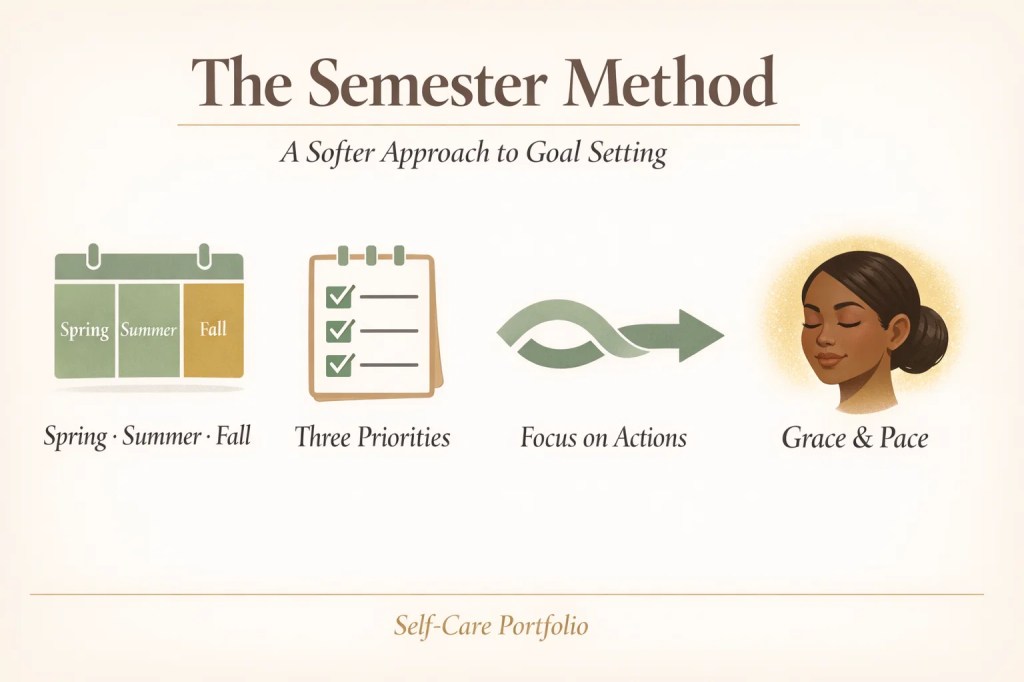
Planning Life in Semesters
| Semester | Months |
|---|---|
| Spring Semester | January – April |
| Summer Semester | May – August |
| Fall Semester | September – December |
This immediately brought the same grounding energy as a syllabus.
Clear expectations. A defined window. Less overwhelm.
One Life, Not Separate Buckets
One idea from Shellye Archambeau that stayed with me was treating work and life as one integrated list, not competing priorities.
That reframing mattered.
Instead of setting endless goals across every area of life, I decided to limit myself to three priorities total per semester across work and life combined.
Not three per category.
Three, period.
Here’s how I structure it:
Three Priorities for One Integrated Life
| Area | This Semester’s Focus |
|---|---|
| Career / Skill Development | |
| Health / Well-Being | |
| Relationships / Community |
This table alone changed how I think about ambition.
It forced honesty.
It removed the pressure to “do everything.”
It made room for intention.
From Goals to What Actually Moves Them Forward
Naming goals is easy.
What’s harder and more important is determining what needs to be done for those goals to move forward.
This is where Shellye’s idea of ruthless prioritization becomes practical instead of harsh.
Once I name my three priorities for the semester. I turn to Shellye’s other idea: shifting my focus away from outcomes and toward actions.
From Goal to Action
| Goal | What Has to Be True |
|---|---|
This reframes the work entirely.
Instead of obsessing over results, I focus on:
- conditions
- habits
- systems
- consistency
The goal becomes a direction not a source of pressure.
Why This Feels Like Self-Care (Not Productivity)
This approach isn’t about doing more.
It’s about doing less, more intentionally.
It honors:
- energy limits
- real life rhythms
- competing responsibilities
- long-term sustainability
It also removes a lot of unnecessary self-judgment.
I did hit meaningful milestones simply by following what felt important but without much structure. This system feels like the natural next step: not tightening the reins, but organizing what already matters.
Self-Care Takeaways
🌿 Structure can be supportive, not restrictive.
A clear container makes it easier to show up.
✨ Three priorities are enough.
Focus creates momentum.
🧘🏾♀️ Actions matter more than outcomes.
Determine what has to be true then work from there.
🌱 Work and life don’t compete — they integrate.
You only have one life to manage.
❓ FAQ
What does “ruthless prioritization” actually mean?
It doesn’t mean being harsh with yourself. It means being honest about your time and energy, and choosing what truly deserves focus in a given season.
Why limit goals to only three per semester?
Because attention is finite. Choosing three priorities creates clarity and momentum without spreading yourself too thin or abandoning what matters most.
Is this a productivity system or a self-care practice?
It’s both. Structure reduces overwhelm, and reduced overwhelm is a form of self-care. This approach supports progress without burnout.
What if my goals change mid-semester?
That’s normal. Semesters are containers, not contracts. You can reassess without scrapping the entire system or judging yourself for adjusting.
How is this different from annual goal setting?
Annual goals often feel abstract and overwhelming. Semester-based planning creates shorter, more realistic windows for focus and follow-through.
What does “what has to be true” mean in practice?
It means identifying the conditions, habits, or actions that allow a goal to move forward rather than fixating on the outcome itself.
Can this work if I’m balancing work, school, and personal life?
Yes. This approach was shaped by managing multiple roles at once. It’s designed for real life and the conditions that come with it.
Final Thoughts
I’m not trying to optimize my life.
I’m trying to support it.
Planning in semesters and prioritizing ruthlessly with care feels like a way to move forward without burning out. It gives me clarity without pressure, ambition without exhaustion, and structure without rigidity.
For this next season, that’s more than enough.
A Note for the New Year (or Anytime You Find This)
You’re allowed to join the process at any point.
If you’re reading this at the start of a new year, you can begin now.
And if you’re reading this in the middle of spring, summer, or fall you can still begin now.
This approach isn’t tied to January. Just like school, progress is made through a combination of moments, efforts, and adjustments over time not a single perfect start.
You don’t have to catch up.
You don’t have to start from the beginning.
You don’t have to do this “on time.”
Choose the semester you’re in. Name three priorities. Focus on what has to be true to support them.
Subscribe to Self-Care Portfolio for reflections on gentle productivity, sustainable routines, and the Solo-Money Series practical self-care for real life.
Related reads:
The 75 Rule: Giving Yourself Grace in a World That Asks You to Overperform – selfcareportfolio
The Highest Form of Self-Care Is Focusing on Your Own Life – selfcareportfolio
Why 30-Minute Naps Changed My Energy and Evenings – selfcareportfolio
 selfcareportfolio