
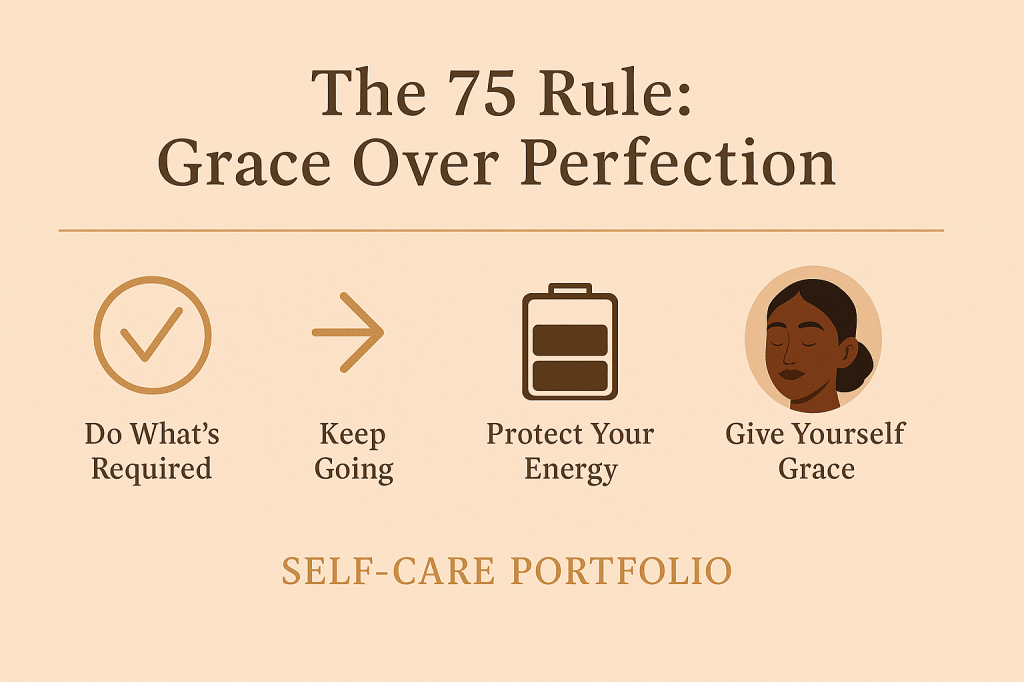
A gentle guide to letting go of perfection, embracing grace, and approaching your goals with sustainability. The 75 Rule helps you move forward without burnout.
The week before finishing my finals, my professor said something that completely reframed how I want to approach the CPA exam and honestly, my life.
We were going over his strategy for studying, and he told me:
“When you’re practicing, once you hit an 80… move on.
Don’t sit there trying to squeeze out more. You’re wasting energy.”
He explained that the CPA is called “the 300 Club.”
Four exams.
A score of 75 required for each.
A total of 300 points to get the license.
“Who cares if you get a 75 or a 90?” he said.
“Passing is passing.
My sister once got a 92 on Audit.
I told her she studied too hard.”
At first, I laughed.
But the more I sat with it, the more it felt like a life lesson disguised as exam advice.
Because sometimes we chase 92s in places where a 75 is more than enough.
The Pressure to Overperform
A lot of us grew up inside a quiet expectation:
- Be the strong one.
- Get everything right.
- Never let anything slip.
- Solve every problem yourself.
- Hold it together no matter what.
- If you can do more, you should do more.
There’s an internal intensity there. This belief that competence means perfection and worthiness means overperformance.
But adulthood teaches a softer truth:
You don’t get extra credit in life for burning yourself out.
You don’t need to ace every season.
You don’t need to prove yourself in every task.
You don’t need to perform at 92 when the requirement is 75.
And beating yourself up for not being exceptional wastes energy you need for the next chapter.
Grace is what keeps people going.
Perfection is what breaks people down.
Grace Is What Makes Long Journeys Possible
I’m learning that grace and steady effort are what carry you through the long chapters of life.
Grace is what allows you to keep showing up.
Grace is what keeps you from collapsing under expectations.
Grace is what helps you release the pressure to be extraordinary every single time you try something new.
Grace says:
- “You’re allowed to pace yourself.”
- “You’re allowed to rest.”
- “You’re allowed to be human.”
- “You’re allowed to do enough not everything.”
Perfection demands intensity.
Grace demands presence.
The 75 Rule in Real Life
The 75 Rule isn’t about aiming low.
It’s about aiming sustainably.
Sometimes the wisest thing you can do is:
- meet the requirement
- complete the task
- preserve your energy
- and move forward
Because moving forward is the real goal.
When you obsess over perfection, you drain the stamina you need for the long game—four CPA exams, a major career shift, a degree, a fitness journey, or even just rebuilding your routines.
Some things don’t need your perfection.
They need your consistency.
Some seasons don’t need your brilliance.
They need your presence.
Some goals don’t require a 92.
They require a pass.
Giving Yourself Grace When the World Wants You to Overperform
We live in a world that encourages us to overdo everything:
the extra hours
the extra effort
the extra emotional labor
the extra stress
the extra proving
But none of that guarantees peace.
None of that guarantees wellness.
None of that guarantees longevity.
In fact, the people who last… the ones who build meaningful careers, stable routines, and emotionally solid lives are the ones who learn to apply grace:
Do what matters.
Release what doesn’t.
Move forward without punishing yourself.
Grace isn’t settling.
It’s sustainability.
Self-Care Takeaways
💛 1. A 75 effort is sometimes the healthiest option.
You don’t need to overperform to be worthy.
🌱 2. Grace conserves energy for the long journey.
Success comes from stamina, not perfection.
🧘🏾♀️ 3. Stop chasing 92s in areas that only require 75.
Your peace matters more than extra points.
✨ 4. Progress is measured by movement, not intensity.
Do enough to move forward and don’t exhaust yourself in the process.
🌼 5. You deserve to be gentle with yourself.
Grace is part of adulthood.
❓ FAQ
What exactly is the 75 Rule?
It’s the idea that you don’t need to be perfect. Aim for what’s required, not what destroys your energy in the process.
Is this about lowering standards?
No. It’s about sustainability. High standards don’t require perfection—they require consistency and care.
Why do so many people feel pressure to overperform?
Many of us were taught that strength means doing everything alone or doing everything flawlessly. But that mindset leads to burnout, not success.
How do I start giving myself more grace?
Begin by setting thresholds:
“If I do this much, I will stop and move on.”
It trains your brain to accept “enough” as valid.
How does this relate to self-care?
Grace protects your emotional bandwidth, mental clarity, and long-term progress. It allows you to keep going.
What if I feel guilty doing just enough?
Your value is not determined by exhaustion. You don’t have to earn your worth through overperformance.
🌸 Final Thoughts
When my professor told me, “You only need a 75,” I didn’t just hear exam advice.
I heard a life adjustment.
I heard:
“You don’t have to be extraordinary to move forward.”
“You don’t have to break yourself to prove yourself.”
“You don’t have to aim for exhaustion to be proud of yourself.”
Grace carries you further than intensity ever will.
Do enough to move forward.
Don’t do so much that you can’t continue.
That’s the 75 Rule.
Subscribe to Self-Care Portfolio for more reflections, gentle productivity, and the Solo-Money Series.
Related reads:
The Highest Form of Self-Care Is Focusing on Your Own Life – selfcareportfolio
 selfcareportfolio