Overwhelmed by multitasking? Here’s how I’m relearning the basics, returning to single-task focus, and rebuilding steady habits that actually support my well-being.
Two small reminders at work were enough to show me where my focus had been slipping.
I was doing too much juggling emails, tasks, and messages and it started to show. Not in the obvious ways (I was still meeting my deadlines), but in the subtle moments that matter to other people. Twice in one month, someone had to remind me about tasks that supported their deadlines.
That’s when it hit me:
I wasn’t missing things because I didn’t care.
I was missing things because I was multitasking my way into overwhelm.
Then I came across a piece in Oprah Daily about monotasking — the idea that focusing on one thing at a time isn’t outdated. It’s a modern survival skill. The author said multitasking isn’t efficiency; it’s self-distraction.
And suddenly, everything clicked.
Why Relearning the Basics Matters More in Your 30s
Going back to school in my 30s taught me this before anything else.
I performed better.
I focused deeper.
I actually enjoyed the learning process.
There’s something different about relearning as an adult. You’re not doing things because someone told you to; you’re choosing them. You’re showing up with life experience, self-awareness, and your own reasons.
That’s why coming back to the basics feels right for me now. It’s not regression — it’s an intentional return.
At 34, I’m realizing something simple but humbling:
The habits that will carry me forward aren’t all new strategies.
Some are old foundations I abandoned.
Relearning the basics is the real upgrade.
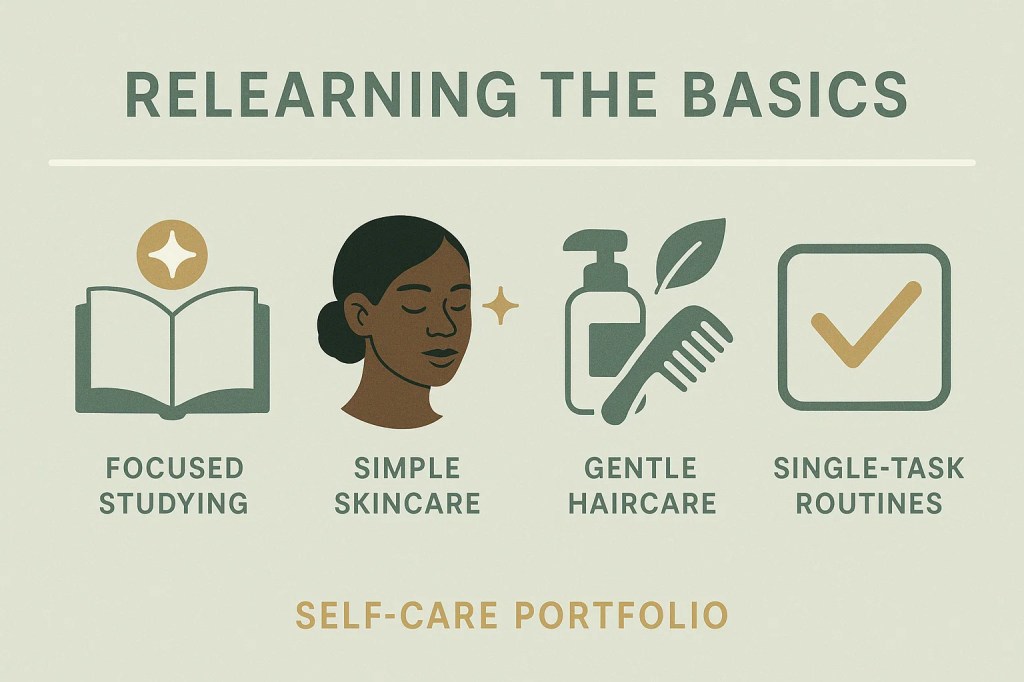
This month, I’m choosing to go back to what actually works — in my focus, my studying, my skin, my hair, and my daily routines.
Here’s what that looks like.
1. Relearning How to Focus: The End of Multitasking
I used to think I could handle it: answering emails while updating a spreadsheet, mentally prepping the next task while finishing the current one. On paper, it looked efficient. In reality, it came at a cost:
- My mind felt noisy.
- My attention was scattered.
- My quality slipped in the areas that needed my full presence.
Reading about monotasking reframed everything:
Single-task focus isn’t doing less.
It’s giving more.
My brain needs clarity, not chaos. The more I simplify, the better I work and the better I feel.
Right now, that looks like:
- One task open at a time on my screen
- Short, focused blocks for emails instead of constant checking
- A simple written list instead of trying to carry it all in my head
It’s not fancy. It’s basic. And it’s working.
2. Relearning Academic Basics: Reading, Comprehension & CPA Prep
One skill I’m actively relearning is deep reading.
Not skimming.
Not jumping between tabs.
Not reading while I’m half-doing something else.
But actually sitting with words.
Reading comprehension is the foundation of almost everything I care about right now:
- storytelling
- writing
- personal growth
- studying for the CPA
- understanding complex questions on exams
- thinking clearly enough to create
Relearning how to read for better comprehension is a form of self-care. It expands my world, improves my focus, and prepares me for the chapters I’m stepping into.
For me, that looks like:
- 20–30 minutes of focused reading without my phone
- Taking brief notes instead of highlighting everything
- Pausing to ask, “What is this really saying?” before turning the page
3. Relearning Skin Basics: Returning to My Vitamin C + Shea Blend
Right out of college, I used to wear a mix of refined shea butter with vitamin C every morning before work. I’d leave the house glowing — foundation-free and confident.
Then life sped up, and that ritual disappeared.
Recently, with hyperpigmentation showing more than I’m comfortable with, I decided to return to that blend. Not because it’s trendy or complicated, but because it worked. And because making it myself felt grounding — like reconnecting with a version of me who took care of her skin with intention, not panic.
Sometimes the simplest routines are the ones that steady you:
- A basic blend you trust
- A few quiet minutes in the morning
- The confidence of knowing you’re caring for your skin, not fighting it
4. Relearning Hair Basics: Ending Damage & Returning to Care
The last few years came with hair damage from practices I’m still unpacking. But I do know this: I used to take care of my hair daily.
I tended to my scalp, moisturized consistently, used the LCO method, and paid attention.
Somewhere along the way, life got too loud.
So now I’m going back to the basics again:
- AM: light moisture for scalp care
- PM: oiling and gentle massaging for scalp care
Not perfectly. Not every single day. But consistently enough to rebuild.
Taking my hair care back into my own hands is grounding. It’s slow, gentle, and honest. It’s a reminder that progress doesn’t need to be dramatic to be meaningful.
Relearning Basics Is Not Regression — It’s Refinement
Relearning didn’t just start this month. It started when I went back to school in my 30s after nearly a decade away.
And the most surprising thing happened:
I did better.
I enjoyed it more.
I showed up for myself because I chose it — not because anyone expected it.
There’s a quiet power in relearning in your 30s. It turns obligation into intention. It turns pressure into purpose.
This is the emotional core of the shift I’m making:
- depth over noise
- presence over panic
- quality over rush
- care over chaos
Relearning the basics isn’t going backwards. It’s returning to what actually keeps you steady.
And from that steadiness, everything else becomes possible: creative work, stronger routines, CPA studying, self-confidence, and emotional clarity.
🌼 Self-Care Takeaways
💛 1. Your brain can’t thrive in noise.
Single-task focus brings your clarity back.
🌿 2. Old habits can be new healing.
Returning to basics is a quiet form of self-respect.
🧘🏾♀️ 3. Simple rituals often carry you further than complicated routines.
📚 4. Deep reading is self-care.
Better comprehension supports your work, your creativity, and your long-term goals.
✨ 5. Relearning is a skill.
It’s a sign of maturity, not regression.
🧴 6. Skin and hair basics count as emotional care too.
Gentle, consistent maintenance builds back trust with your body.
❓ FAQ
Why am I struggling to focus more in my 30s?
As life gets fuller, your brain has more inputs competing for attention. Constant context-switching (emails, notifications, tasks) increases mental fatigue. Simplifying your routines and focusing on one thing at a time reduces that cognitive load and helps your focus return.
Does monotasking really help productivity?
Yes. Single-task focus tends to increase accuracy, reduce stress, and improve long-term retention especially for studying, problem-solving, and creative work. You get fewer mistakes and more peace.
How do I start monotasking if I’m used to multitasking?
Start small. Try 10–15 minute focus blocks for one task: reading, email, or one work project. Silence notifications during that block, then take a short break. Gradually lengthen the blocks as your brain adjusts.
What does “relearning the basics” actually look like in real life?
It can be as simple as: washing your face the same way every night, going back to a skincare blend you trust, rebuilding a simple hair routine, or committing to one focused study session a day. It’s less about perfection and more about consistency.
Is going back to old routines a sign I’m moving backwards?
Not at all. Returning to what worked is a form of wisdom. You’re choosing habits with more information, more experience, and a clearer understanding of what you actually need now.
How do I know which basics to return to?
Look for routines that made you feel steady, clear, or confident not drained or frantic. Ask yourself: What did I use to do when I felt more grounded? Start there and rebuild one small habit at a time.
Can relearning help with bigger goals like career changes or exams?
Yes. Strong basics — focus, reading comprehension, simple care routines give you the mental and emotional stability to handle bigger goals. When your foundation is steadier, you have more energy for things like CPA studying, job shifts, or creative projects.
Subscribe
Want more reflections on focus, emotional wellness, and building a softer, steadier life?
Related Reads:
Reclaim Your Time: Active vs Passive Habits That Build You Back – selfcareportfolio
Self-Care Practices: Walking the Crescent City Connection Bridge – selfcareportfolio
 selfcareportfolio