The Two-Task A Day Method helped me stop multitasking, ease anxiety, and simplify my routines. Here’s how choosing one AM task and one PM task changed everything.
For a while now, I’ve been noticing something about myself I couldn’t ignore.
I was doing too much juggling emails, tasks, messages, responsibilities and my mind never felt settled. Not in a dramatic way, but in the small, subtle ways that build up. I’d wake up feeling behind. I’d go to bed feeling rushed. I’d write long to-do lists and never finish them. And every day felt like there wasn’t enough time.
These feelings have been around me for a while… but recently, it became louder.
I realized I was multitasking my way into anxiety.
And weirdly, I wasn’t even getting more done I was just exhausting myself.
Going Back to the Basics (Without Realizing It)
A few years ago, I had this habit of buying cute planners from the dollar store color-coded lists, undated calendars, pretty notepads. They always felt hopeful, like I was about to become a super-organized version of myself.
But the reality?
I wasn’t doing anything on the lists.
I would push tasks from:
morning → afternoon → evening → tomorrow → next week.
Then I’d start fresh, skip days, skip weeks, and repeat the same cycle.
My lists weren’t helping me.
They were overwhelming me.
One day, something clicked:
What if I stopped trying to do everything…
and focused on doing just one thing?
Not 10 tasks.
Not a long list.
Not a new system.
Just:
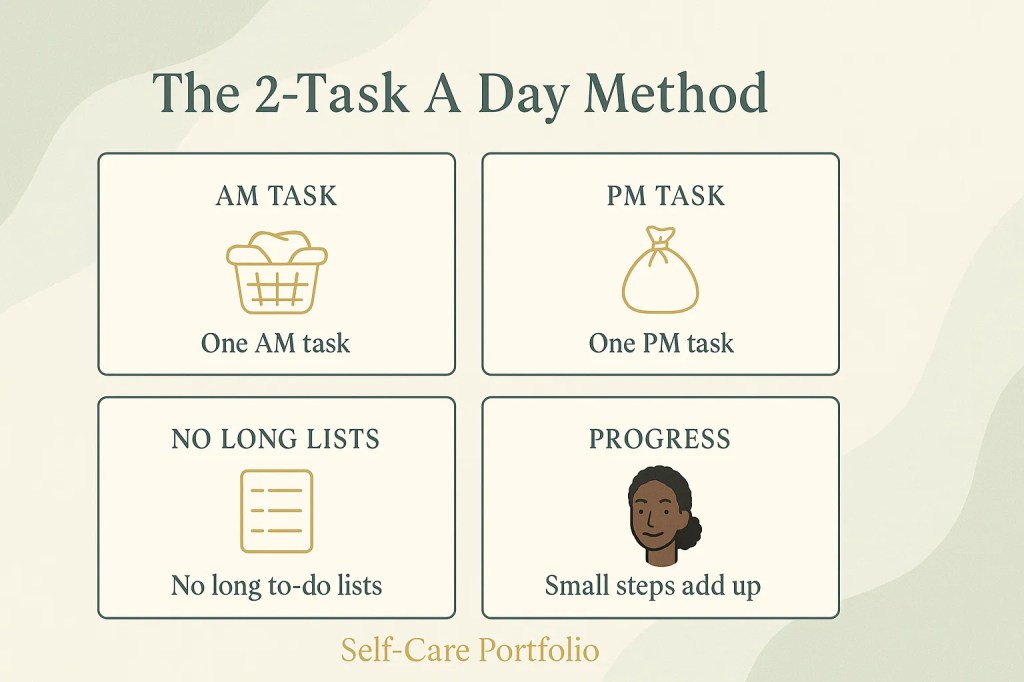
One AM task.
One PM task.
That’s it.
And suddenly everything felt lighter.
🌞 Why One Task in the Morning + One Task in the Evening Works
The beauty of the AM/PM approach is how simple it feels.
It gives your day structure without suffocating you.
It gives your mind direction without pressure.
It gives your energy purpose without burnout.
When I choose one thing in the morning and one thing at night, I notice a shift:
- I don’t feel rushed.
- I don’t feel behind.
- I don’t feel like there’s a laundry list waiting for me.
- I don’t feel that heavy, panicky “there’s not enough time” feeling.
It slows down time in this weird but peaceful way.
And when you add it up?
Fourteen small things completed in a week —
without overwhelm, without burnout.
Doing less actually helped me do more.
🌞 How This Method Showed Up in My Work Life (Without Me Realizing It)
When I look back, I realize I’ve been using a version of the 2-Task Method for years — even at a previous job where I had weekly production goals.
Back then, I naturally split my workday in half:
Mornings → complex tasks
Afternoons → simpler tasks
I didn’t do this because someone told me to.
I did it because it worked.
Other productivity systems never stuck.
Color-coded lists… batching… timers… elaborate planning… none of it lasted.
But simplifying my day into two parts?
That’s what kept my workflow steady.
And doing the hardest thing first — then switching to something simple after lunch — kept me consistent, focused, and on track every single week.
It was essentially the same structure as:
One meaningful task in the AM.
One grounding task in the PM.
Even before I named it, my brain already knew:
simplicity is what helps me thrive.
🌿 Why This Works (Psychologically & Emotionally)
This method works because it removes decision fatigue.
When your brain sees a long list:
your stress spikes
your motivation drops
your focus scatters
your energy dilutes
When your brain sees one task:
it relaxes
it focuses
it completes
it moves on
And because your day now has a beginning and an end, it builds rhythm:
AM = your anchor
PM = your wind-down
Two touchpoints.
Two moments of intention.
Two chances to feel capable.
That’s it.
📘 How It Connects to My “Relearning the Basics” Season
This fits beautifully into the season of life I’m in — the one where I’m relearning how to slow down, simplify, and return to what actually works.
This method supports all the things I’m rebuilding:
- my reading routine
- my study habits
- my skin rituals
- my hair care
- my creativity
- my health
- my peace
Two tasks a day makes space for all of it — gently.
🧘🏾♀️ How the 2-Task Method Quieted My Anxiety
When I switched to this approach, something unexpected happened:
My anxiety softened.
Because I wasn’t rushing anymore.
I wasn’t chasing time.
I wasn’t panicking about doing everything at once.
I wasn’t carrying guilt.
One AM task.
One PM task.
It created a sense of enoughness.
Time stopped feeling tight.
And when you feel like you have enough time… everything shifts.
🌼 Where I’m Using This in My Life Right Now
Here’s how the 2-Task rhythm is supporting me right now:
AM Tasks
- tidy one small thing
- read for 10–20 minutes
- moisturize my scalp
- revisit my gratitude list
- study one concept
- start writing a paragraph
PM Tasks
- pick up clutter
- prepare clothes for tomorrow
- wash my face intentionally
- write one gratitude or affirmation
- organize one drawer or section
- reflect on something that went well
These aren’t heavy tasks.
They’re grounding ones.
🌱 This Isn’t Productivity Training — It’s Self-Care
I’m not doing this to be more productive.
I’m doing it to breathe.
To feel calmer.
More present.
More in control.
More aligned with myself.
More grounded in my own rhythm.
This method works because it honors the truth:
You don’t need to do everything to feel accomplished.
You just need to do what matters.
And often — what matters fits into two moments:
One in the morning.
One in the evening.
✨ Self-Care Takeaways
✔ Do less, but do it with intention.
✔ Two tasks a day is enough.
✔ Slow systems support a steady life.
✔ If you feel rushed, simplify.
✔ Small actions build real momentum.
❓ FAQ
What is the AM/PM Method?
It’s a simple productivity approach where you choose one meaningful task for the morning and one grounding task for the evening. It reduces overwhelm and builds steady momentum.
Why only two tasks a day?
Because long to-do lists trigger anxiety and avoidance. Two tasks create clarity, focus, and a sense of time expanding instead of collapsing.
Does this method really help with overwhelm?
Yes. Simplifying your day lowers mental load, increases focus, and prevents burnout. It also creates more emotional space to think clearly.
Can I use the AM/PM Method at work?
Absolutely. I naturally used a version of this at a previous job tackling complex tasks in the morning and simpler tasks after lunch. It helped me stay consistent with weekly production goals.
What kinds of tasks count as AM/PM tasks?
Think small but meaningful: email cleanup, laundry, paying a bill, studying for 25 minutes, wiping a counter, doing your hair, journaling, or reviewing notes.
How do I stay consistent with this routine?
Make it visual. Put it on your planner, use the AM/PM template on my Pinterest, or pick tasks the night before. Consistency comes from gentleness, not pressure.
Subscribe to Self-Care Portfolio
If this post resonated, subscribe to the Self-Care Portfolio for more reflections, self-care experiments, and practical strategies like the AM/PM concept. Each post is a gentle reminder that progress doesn’t have to be perfect to count.
Related reads:
Reclaim Your Time: Active vs Passive Habits That Build You Back – selfcareportfolio
 selfcareportfolio