
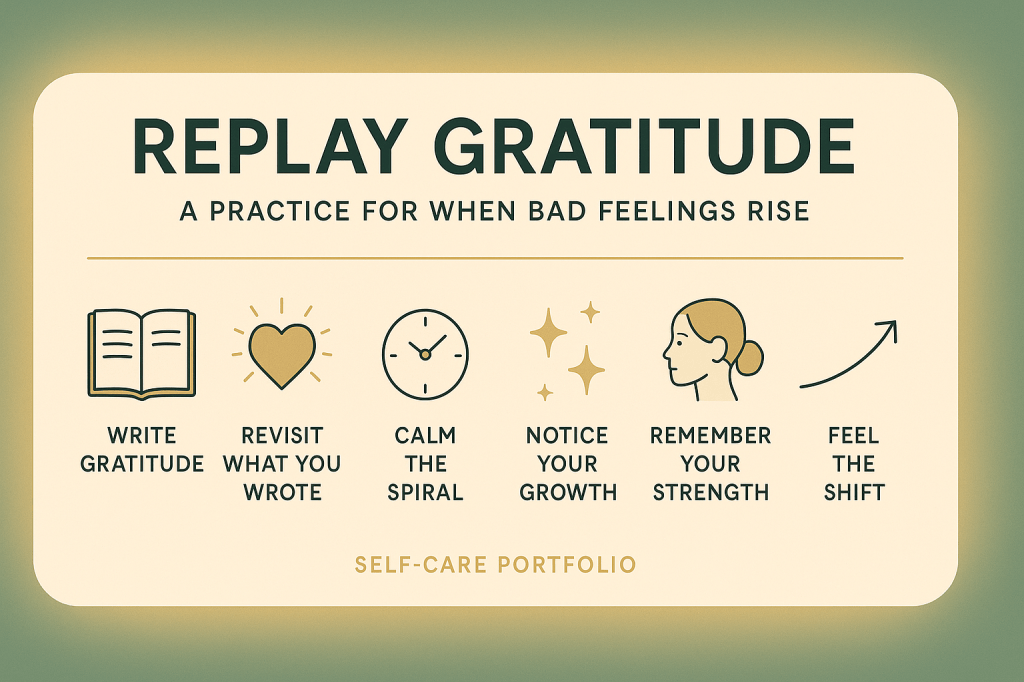
Replay past gratitude to calm bad feelings, reduce spirals, and remember how far you’ve come. A simple emotional wellness practice inspired by happiness research.
Sometimes a bad mood isn’t about what’s happening today it’s the echo of something you’ve already survived. And in those moments, it can feel like your mind is pulling you back into an old emotional room you’d rather not revisit.
A few years ago, I learned a simple practice that helped me shift out of those moments: replaying past gratitude.
Not rewriting. Not forcing positivity.
But revisiting what I wrote during older, harder chapters and remembering how far I’ve come.
It started during a job that drained me. I had a manager who made work feel heavier than it needed to be. I was torn between staying (and worrying that a short tenure would look bad) or leaving to protect my peace. It felt like a no-win situation.
In those weeks, gratitude was the only thing that stabilized me. Writing down small moments of good even when the day felt bad instantly softened the weight on my chest. Eventually, I found the courage to leave that job, and when I look back, I realize gratitude is what helped me stay steady long enough to get out.
Replay Gratitude came later.
I heard Oprah and Arthur C. Brooks discuss an approach to gratitude in a conversation, and one idea stood out to me:
when your mood drops, write down three to five things you’re grateful for.
I tried it and it worked but eventually, I added a twist.
Instead of writing new gratitudes every time I felt low, I began rereading the gratitudes and affirmations I had already written.
Suddenly it clicked:
Seeing who you were then and who you are now is a gratitude practice of its own.
Replaying my gratitude helped me notice:
- the job I once prayed to escape… I escaped
- the emotional heaviness I wrote about… I moved through
- the uncertainty I journaled… I survived
- the growth I hoped for… I’m living in it
It’s one thing to write gratitude.
It’s another thing to witness your evolution in your own words.
That’s when I realized something deeper:
**Replay Gratitude isn’t about positivity.
It’s about emotional regulation.**
When a bad feeling returns fear, insecurity, shame, self-doubt replaying past gratitude reminds your brain:
“You’ve been here before.
And you made it out.”
It pulls you out of the emotional spiral and back into the truth of your own resilience.
🌱 Replay Gratitude: The Emotional Wellness Behind It
Replay Gratitude works by interrupting the brain’s habit of replaying fear, anxiety, and negative emotions.
Neuroscience shows that when you revisit old memories with new perspective and evidence of your growth, the emotional intensity decreases. This process, known as memory reconsolidation, helps you release emotional attachment to past struggles and see them with more clarity.
Practices like gratitude and intentional reflection have been shown to:
- reduce emotional volatility
- increase long-term happiness
- rewire the brain toward calm
- break repetitive negative thought loops
Gratitude is often described as a grounding practice a method of returning to clarity when life feels loud or overwhelming.
Replay Gratitude brings these ideas together:
Write the truth — and
Remember the truth.
It’s not about performing happiness or pretending everything is fine.
It’s emotional maintenance a reminder that your past self left you a map, showing you the strength and resilience that got you this far.
🌿 Community Insight: Why This Practice Matters Now
Across so many conversations, people talk about how emotionally heavy it can feel to hold everything together. Many of us grew up learning to focus on others’ needs first, manage other people’s emotions, or push through discomfort without ever acknowledging our own.
But carrying that much emotional weight alone can leave you drained.
Practicing and Replaying Gratitude offers a gentle way to shift the focus back to yourself.
It reminds you that your growth is real.
Your resilience is real.
Your experiences matter.
When specifically bad feelings surface, this practice becomes a quiet form of self-preservation a way to come home to yourself and reconnect with the parts of you that survived, healed, and kept going.
🌼 Self-Care Takeaways
💚 1. Bad feelings don’t mean you’re back where you started.
Replay gratitude shows you the progress your emotions can’t always see.
💛 2. Your past self left you evidence of your strength.
Revisit it. Let it ground you.
🌿 3. Gratitude isn’t pretending everything is good it’s noticing what’s still holding you up.
🧘🏾♀️ 4. When you feel overwhelmed, reread what helped you before.
Your own words can be a source of comfort.
❓ FAQ
What is Replay Gratitude?
It’s the practice of rereading old gratitude entries or affirmations to calm emotional spirals and remind yourself of past resilience.
Does gratitude actually help mood?
Yes. Studies show regular gratitude increases emotional regulation, reduces stress responses, and boosts long-term happiness.
When should I use Replay Gratitude?
Use it anytime a bad feeling returns anxiety, self-doubt, sadness, shame, or overthinking.
✨ Subscribe
Want more reflections on consistency, creativity, and real-life self-care practices?
Subscribe below to get updates when new Self-Care Portfolio posts go live.
Related Reads
Self-Care Practices: Walking the Crescent City Connection Bridge – selfcareportfolio
 selfcareportfolio