
My Take: How Coaching Helped Me See What Was Draining My Joy
Work-life balance in accounting isn’t easy. A recent conversation with my life coach helped me realize I didn’t need a new job, I needed career autonomy.
When she asked how work was going, I told her I was thinking about leaving for another role next year. I was confident about the idea at first. But then she paused and asked, “What do you want next?”
She encouraged me to write down what I wanted from my next career move not just the title or company. That’s when it clicked.
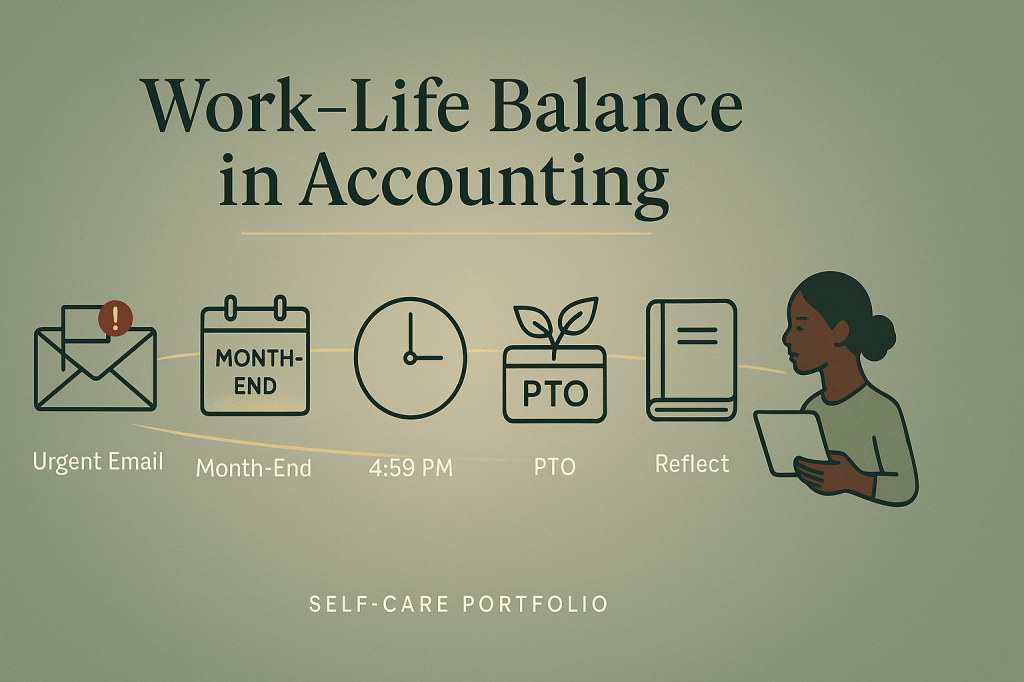
For months, I’ve felt like my workday has no edges. I do daily tasks, juggle beginning, mid, and end-of-month deadlines, and handle constant follow-up questions that send me searching. Last night, as I was reflecting on her question, it hit me why I’ve built up so much unused time off because I never stop long enough to notice the calendar.
Working with my coach made me name it what I’m craving isn’t escape; it’s breathing room. I want work that gives me space to think, to create, to rest, instead of living by the clock and everyone else’s deliverables.
📉 The Bigger Picture: Why So Many Accountants Feel the Same Way
Reading “Unmasking the Exodus” from RightWorks Inc. felt like reading my own thoughts out loud. The article listed reason after reason accountants are leaving the profession.
And it’s not just about burnout it’s showing up in the data, too.
According to a recent report by the American Institute of CPAs, the number of U.S. students graduating with accounting degrees fell another 6.6% during the 2023–2024 school year, following two years of even steeper declines. (Source: CFO Dive, Oct. 27, 2025).
Fewer students entering the field and more professionals leaving points to a larger truth: accounting isn’t just losing people, it’s losing patience. The profession’s structure hasn’t kept up with how people actually want to live and work.
The article listed reason after reason accountants are leaving the profession:
- Work-Life Imbalance — long hours and constant deadlines that blur the line between work and life.
- Monotonous, Repetitive Tasks — the slow death of creativity in a field that once promised problem-solving.
- Limited Career Growth — feeling “stuck” on the same ladder.
- Technological Disruption — fear of being replaced instead of supported by automation.
- Low Autonomy and Decision-Making Power — doing the work but never owning the direction.
- Financial Discontentment — pay that doesn’t always match the pressure.
Even though work-life balance gets the headlines, it’s the combination of these smaller weights that adds up. It’s the accumulation of “always on,” not just one bad week.
🧩 What I Learned About Myself
Seeing the pattern was sobering. I realized my frustration wasn’t just about outgrowing my role but it was about rhythm.
There’s never a pause between cycles, so I never feel “done.” I’m always preparing for what’s next.
And when everything feels urgent, nothing feels creative.
It’s hard to dream about new ideas when you’re buried in emails, invoices, reconciliations, and month-end duties etc.
For my peace of mind and my joy; I don’t want to keep living this way. I’m still pursuing my CPA goal since I’m close to my 150-hour mark, but I’m also giving myself permission to pivot.
Maybe that means working in a different industry like the school system. Maybe it means something outside of accounting altogether.
I don’t know yet. But now I understand why I’m exploring change instead of feeling guilty for wanting it.
🌱 What “Career Autonomy” Really Means
Autonomy isn’t rebellion; it’s alignment.
It’s the freedom to design work that leaves space for life, curiosity, and calm.
For me, autonomy would mean:
- No constant start-mid-end-of-month deadlines.
- Fewer daily reactive tasks for other people.
- Time to think and plan, not just execute.
- Flexibility in schedule and energy flow.
And honestly? That’s self-care.
Peace doesn’t come from just quitting and moving to the same scenerio but it comes from choosing the rhythm that fits who you are now.
🪞 Self-Care Takeaways
💰 Financial Well-Being: A stable paycheck doesn’t mean peace if your time feels borrowed.
💡 Skill Development: Growth isn’t just about certifications; it’s learning when to pivot.
🎨 Creativity & Expression: Every job has space for creativity; sometimes you just need to move closer to it.
💚 Physical Well-Being: Unused PTO take a quiet toll rest is not a reward; it’s fuel.
🌿 Community & Connection: Talking with mentors or a coach can turn confusion into clarity you’re not the only one rethinking what stability means.
🔍 FAQ
Q: Why are so many accountants leaving the profession?
A: Research shows burnout, work-life imbalance, repetitive tasks, and limited flexibility are the leading reasons behind the “accountant exodus.”
Q: Is accounting still worth it in 2025?
A: Yes but only if you define your own version of success. Many professionals are shifting toward roles with autonomy, flexibility, and advisory focus.
Q: Can accountants have a good work-life balance?
A: Some do, especially in government roles. The key is finding environments that respect time off and sustainable deadlines.
Q: Are accountants being replaced by AI?
A: No, automation is removing repetitive tasks, there is still a need for strategic human thinking and the catching of errors. The field is transforming, not disappearing.
📝 Journal Prompt
Where in your career do you feel most restricted and what would autonomy look like if you had it?
📬 Subscribe
Want more reflections on balancing ambition with peace?
Subscribe below for new posts about work-life autonomy, growth, and practical self-care for professionals.
What If I Took My Own Advice: A Self-Care Foundation – selfcareportfolio
Reclaim Your Time: Active vs Passive Habits That Build You Back – selfcareportfolio
How to Grow on LinkedIn (My Story Without Being Loud) – selfcareportfolio
 selfcareportfolio