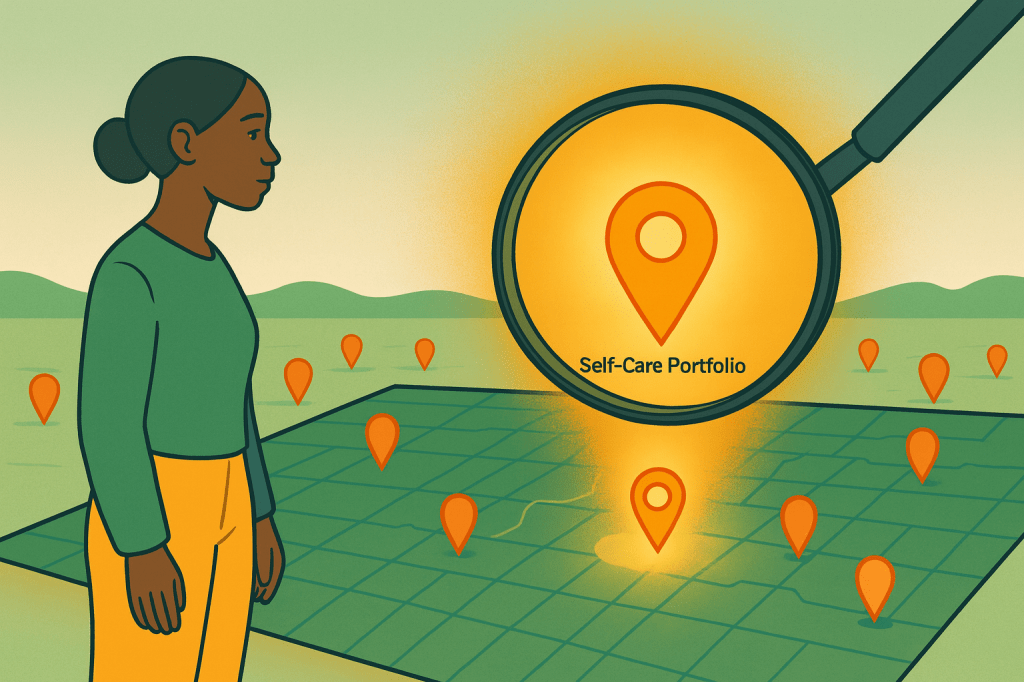
Back in July, my Self-Care Portfolio blog didn’t exist anywhere outside my WordPress site and a few social handles. If you typed my blog name into Google or Bing? Nothing. Just an empty search box and me wondering if I’d ever be findable. I went through 10 pages on Google and saw… nothing.
Fast forward to now: search “Self-Care Portfolio” or variations of it and my site shows up on the first page, in the Top 3 results right next to a major Amazon listing and a classroom mental health site. It’s surreal. And honestly? It feels like proof that quiet, consistent effort works.
How I Got Here (Messily and Proudly)
I didn’t hire anyone. I didn’t buy ads. I didn’t start with SEO expertise. I just started and kept going:
- Rebuilding my website myself – I taught myself WordPress, redesigned my layout until it felt like me, and stuck to my muted green branding even when I second-guessed it. I even tried hiring someone for my landing page, but when it went sideways, I canceled the order and kept going on my own.
- Starting Pinterest in July – I began with 4–6 pins/week, then recently shifted to 2–3 higher-quality pins on rotation. I space them out so I’m not spamming the same link. Now, I’m at nearly 3.5k monthly views and it’s still climbing.
- Creating a consistent style – I built a dedicated chat in ChatGPT for my YouTube and Pinterest planning so everything I publish looks and feels cohesive.
- Letting Google and Bing catch up – Posting consistently, linking my socials, and learning how indexing works slowly pushed my site onto search engine radar.
The Full-Circle Moment: Top 3 on Google and Bing
Seeing my site show up next to Amazon and mental health resources on the first page was more than a vanity win; it was validation.
Another small moment of validation? When I searched “Self-Care Portfolio” on Google and clicked into AI Mode, my own logo appeared in the generated breakdown. That was surreal seeing my brand not just indexed, but visually recognized.
Search engines are competitive, and breaking into the top spots means your site is seen as credible, consistent, and useful.
What made the difference? I leaned into what I could control: my content, my design, and my persistence. Every blog post I wrote, every pin I scheduled, and every update I made to my site signaled, “I’m here and I’m active.”
Self-Care Takeaways from Building a Blog
What does ranking on Google have to do with self-care? More than I realized.
- Journaling your progress (Skill Development) – Being able to see how far I’ve come matters. I wish I had screenshotted every version of my site along the way. Just like journaling helps you process growth, keeping track of changes would have given me perspective when progress felt slow.
- Consistency as connection (Community & Connection) – Just like showing up weekly for a workout or a class builds trust with people, showing up online (even quietly) builds trust with search engines. Consistency is its own form of care it proves to yourself that you’re serious.
- Boundaries with platforms (Physical Well-Being) – I tried being everywhere (Instagram, Tumblr), but it was too much. Simplifying to Pinterest, YouTube, and Spotify gave me breathing room. Boundaries with social media = space to keep creating.
- Reflection as fuel (Creativity & Expression) – Seeing my logo in Google’s AI Mode didn’t just feel validating it reminded me that reflection matters. Pausing to notice wins keeps you motivated for the long game.
What’s Working for Me (and Could Work for You)
- Engage where it counts: I’ve tried being everywhere: Instagram, Tumblr (because I genuinely love it) but it was too much. I’ve since simplified my strategy. Now I focus on platforms that make the most sense for me and my audience.
- Update as you grow: Don’t wait until it’s perfect. Start, then optimize. I first picked up this tip from a Redditor, and it shifted how I approached my site. Instead of stalling, I posted, learned, and refined along the way. That rhythm built more progress than waiting for flawless.
- Be patient with indexing: Search engines take time to notice new sites. I didn’t rush it, I posted consistently, linked my socials, and refined my content. Using Google Search Console to request indexing when I published new posts helped speed up visibility. Over time, that quiet consistency pushed me from “invisible” to Top 3 on Google and Bing.
Self-Care Takeaway
Your blog or any project you’re building isn’t just about algorithms. It’s about the practices that keep you steady: journaling your progress, setting boundaries, showing up with consistency, and pausing to reflect.
Ranking in the Top 3 was proof that those self-care practices work not just for life, but for building something meaningful too.
FAQ
How to get the first page on Google?
There isn’t one shortcut. What’s worked for me so far is focusing on clean titles, simple URLs, consistent posting, and adding FAQs so my posts are easier for both people and search engines to scan.
How to get the first position in Google search?
Position one usually comes with time, authority, and updates. I’m testing steady posting, updates, and keyword refinements while letting consistency do its work.
Does connecting social platforms help SEO?
From my experience, yes. Pinterest drove steady traffic, YouTube added authority, and linking everything back to my site showed Google I was active and consistent. It wasn’t instant, but those external signals helped push my blog onto the first page.
📝 Journal Prompt
What small change could you make to your blog (or project) this week that future you might thank you for?
📬 Subscribe
Like this reflection? Subscribe below for Self-Care Reminders and get new posts, strategies, and personal experiments delivered straight to your inbox.
Related reads:
 selfcareportfolio