
Making friends as an adult is hard. Our schedules are packed, social circles are already formed, and remote work makes it easy to go days without face-to-face connection.
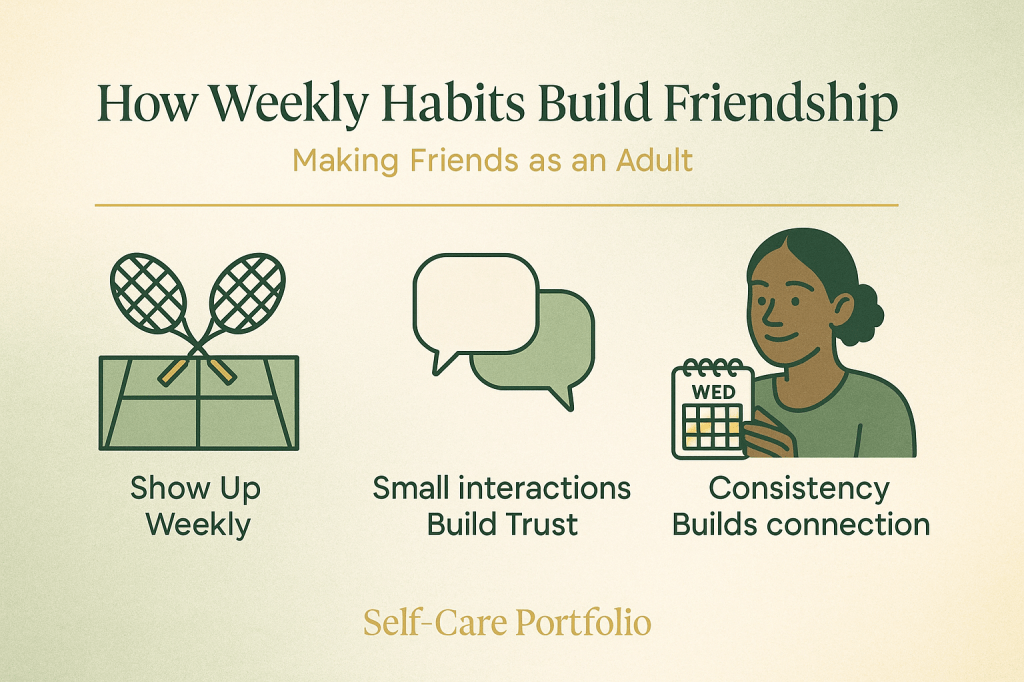
But the summer of last year, something shifted for me. I joined a weekly tennis class. By week two, people were exchanging numbers. By week four, we had a group chat, meet-ups outside of class, and even a running club.
That’s when I realized: consistency builds connection.
🎥 Prefer a quick visual version?
Here’s the short video where I talk about how joining a weekly tennis class changed how I approach friendships and connection as an adult.
A Tale of Two Experiences
For three years, I volunteered with an organization I loved. We met every other month, sometimes quarterly. The people were kind, and I built solid professional ties. But each time, it felt like starting over: reintroducing ourselves, catching up on months of life, warming up all over again.
The tennis class was different. Weekly check-ins built familiarity. We picked up where we left off. By showing up regularly, the walls came down faster. People stopped performing and started revealing.
Why Weekly Builds Connection
Weekly routines work because they:
- Build trust with others (people start to expect you).
- Build trust with yourself (you prove you’re dependable).
- Remove pressure (you don’t need to dazzle anyone just show up).
- Create comfort (conversations flow more naturally week to week).
Consistency is what transforms small talk into real connection.
Advice From My Tax Lady
At her 60th birthday, my tax lady showed me a photo with 30 friends. She explained she’d met most of them simply by being a regular at a local bar. Nothing fancy just showing up.
That moment stuck with me. Not because I want to be a bar regular, but because I want to be a regular somewhere.
My Sunday Class Experiment
This recent summer, I tested this idea again. I joined a Sunday morning fitness class. The group was consistent, friendly, and mostly in their 20s–40s. By my second class, I was already chatting with someone after. Small, but progress.
I eventually ended up finding a workout partner to work out with a couple of times during class so this really does works it’s just the consistency as with everything!
Unfortunately, once September rolled in, school took priority and I couldn’t keep the same rhythm. Still, I noticed something: I have quietly become a “regular” at my local library. Showing up there week after week studying has given me a similar kind of familiarity I felt in that workout class.
You can become a regular anywhere. It doesn’t have to be fitness or social events. Even the library, with its quiet routines and familiar faces, can provide that steady sense of connection.
What I’d Tell Someone Else
If you’re struggling to make friends, try becoming a regular somewhere. It doesn’t have to be deep or complicated. Just:
- Pick one thing (a class, a café, a meet-up).
- Show up 2–3 times a month.
- Give it at least six weeks.
- Notice the small wins (a chat, a smile, feeling more at ease).
You don’t need a game plan. Just consistency.
🌱 Self-Care Takeaways
- Growth in friendship doesn’t come from one-time meetups, but repeated presence. (Community & Connection)
- Weekly commitments build emotional deposits — small, steady investments in belonging. (Well-Being)
- Consistency helps introverts too: when the pressure is off, connection happens naturally. (Skill Development)
- Becoming a regular is self-care — it grounds you and opens doors you didn’t know were there. (Community & Connection + Well-Being)
FAQ
Is it hard to make friends as an adult?
Yes. Busy schedules, existing circles, and fewer organic meetups make it harder. That’s why weekly commitments (like a class, club, or meetup) give adults a natural rhythm to build connection.
What is the hardest age to make friends?
For me, it feels hardest in my 30s. By then, people are focused on establishing their households, hitting career goals, and starting new traditions. Friendships can fall down the priority ladder until kids are older or routines settle. That’s why consistency matters it keeps you on each other’s radar even during the busiest seasons.
How to make friends as an adult with social anxiety?
Weekly habits help here too. Instead of forcing big events, start with smaller, consistent spaces like a workout class or recurring meet-up. Familiarity lowers the pressure. You’re not “performing” for strangers each time you’re slowly becoming part of the room.
What is the 7-year friend rule?
The idea is that friendships naturally fade or shift every seven years. I’ve seen that happen myself, but I’ve also found ways to keep some connections alive. Once a friendship is established, it may not need weekly touchpoints monthly or quarterly check-ins can sustain it. I use a mix of habits:
- A movie pass with one cousin keeps us bonding monthly.
- A fitness routine with another friend which led us to run our second 6K together.
- Shared interest in creativity and projects keep me connected with two others who have their own creative projects as well.
For me, the trick is having at least one thing in common that carries the friendship forward: a ritual, interest, or activity that keeps the relationship alive even if life gets busier.
📝 Journal Prompt
Where’s one place you could commit to showing up weekly (or at least regularly) not for productivity, but for connection?
📬 Subscribe
Want more reflections on habits, connection, and self-care? Subscribe below to get updates when new posts go live.
Related reads:
 selfcareportfolio